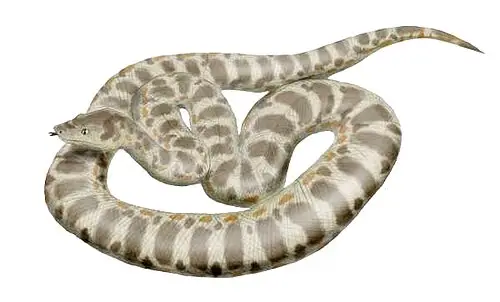
 🎨 Restoration
Restoration: Nobu Tamura email:nobu.tamura@yahoo.com www.palaeocritti.com · CC BY 3.0 · Wikimedia Commons Source
Life restorations are artistic reconstructions based on fossil evidence; true coloration and soft-tissue details remain uncertain.
Titanoboa
Titanoboa cerrejonensis (Titanoboa · Titanoboa)
Known only from fossils. The IUCN Red List assesses only species extant since 1500 CE, so fossil taxa are not assigned a category.
💡 Everyday Comparisons for Size, Mass & Speed
- 💡 The Florida Museum of Natural History describes this snake as being as long as a school bus and as heavy as a small car.
- 💡 A living anaconda compared in the same account is 17 feet (about 5.2 m) long, making Titanoboa about 2.6 times as long (Comparison).
Reference standards: coach bus ~12 m, mid-size car ~4.9 m, compact car ~1 t, basketball hoop 3.05 m, credit card 8.56 cm.
Site-computed relative index from recorded values; not a formal scientific metric.
📖 1. Overview
Titanoboa cerrejonensis (genus Titanoboa) was the largest snake ever known to have lived, inhabiting Colombia during the Paleocene. It lived in a tropical ecosystem about 6 million years after the extinction of the dinosaurs.
🦴 2. Anatomy & Morphology
It was a giant boa-like snake, and its length is estimated from the diameter of its vertebrae at 42–45 feet (about 12.8–13.7 m). Its body was so thick that a researcher remarked it would have had to squeeze through a doorway.
🔍 3. Fossil Record & Paleoecology
Many bones of large turtles and crocodile relatives have been found at the same site, suggesting that it preyed on them. Because the body size of ectothermic animals such as snakes is limited by temperature, this snake is used as evidence that the equatorial region was much warmer then than it is today.
🇰🇷 4. Connection to Korea
No direct record connecting this species to Korea has been found.
📚 Sources & References
- • Fossil taxon — the IUCN Red List assesses only species living or extinct since 1500
- • paleobiodb.org — basicTaxonInfo
- • wikidata.org — Q16519033
- • commons.wikimedia.org — File:Titanoboa NT.jpg
- • floridamuseum.ufl.edu — at-45-feet-long-titanoboa-snake-ruled-the-amazon
- • Silhouette: PhyloPic — Nobu Tamura (modified by T. Michael Keesey) · CC BY 3.0
Recorded dimensions are widely cited representative estimates from public literature and may vary by study or specimen.