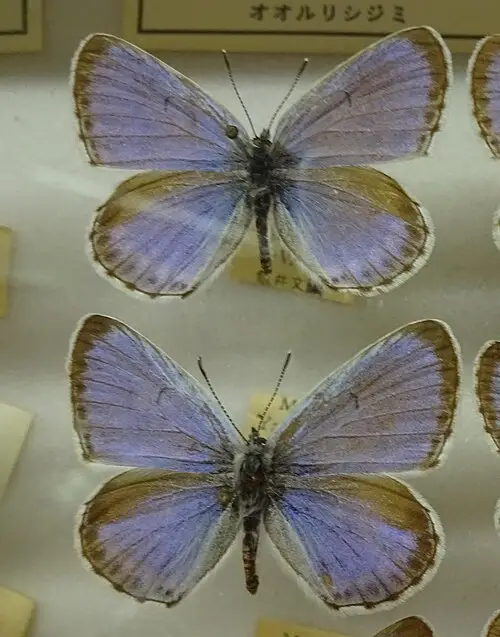
 📸 Photo
Photo: コミスジ空港 · CC BY-SA 4.0 · Wikimedia Commons Source
Shijimiaeoides divina
Shijimiaeoides divina (Shijimiaeoides divina · オオルリシジミ)
Not Evaluated (NE) on the IUCN Red List yet.
🇰🇷 Class I endangered wildlife (Korea)
💡 Everyday Comparisons for Size, Mass & Speed
- 💡 A maximum wingspan of 36 mm is about 1.4 times the diameter of a Korean 500-won coin (26.5 mm) (Comparison).
- 💡 It lives in grasslands close to people, such as tended grave mounds and embankments beside rice paddies and fields. When such grasslands disappear, this butterfly declines with them.
Reference standards: coach bus ~12 m, mid-size car ~4.9 m, compact car ~1 t, basketball hoop 3.05 m, credit card 8.56 cm.
📖 1. Overview
Shijimiaeoides divina is a small blue butterfly living in grasslands around low hills and fields, and is a Class I endangered wildlife species in Korea.
🦴 2. Anatomy & Morphology
Its wingspan is 31–36 mm; the upper side is bluish gray, while the underside is grayish on a white background with black spots lined up parallel to the margin. A band of red markings runs inside the margin of the hindwing.
🔍 3. Ecology & Behavior
Adults appear in May–June, and females lay eggs singly on flower buds of Sophora flavescens. Larvae grow during the blooming period of Sophora flavescens and pupate right away, while adults sip nectar from flowers of daisy fleabane, thistle, and wild strawberries.
🇰🇷 4. Connection to Korea
It is a Class I endangered wildlife species (Korea). Confirmed in places such as Yeongwol in Gangwon-do and Danyang and Jecheon in Chungcheongbuk-do, its decline is attributed to illegal collecting and habitat loss as grasslands shrink.
📚 Sources & References
- • 멸종위기 야생생물 Ⅰ급 — 국가생물종목록(국립생물자원관) ktsn 120000034474 — https://species.nibr.go.kr/home/mainHome.do?cont_link=009&subMenu=009002&contCd=009002&ktsn=120000034474
- • IUCN Red List: not evaluated (NE) — cross-checked with the Wikidata conservation-status entry
- • Korean protection status: Class I endangered wildlife (Korea)
- • catalogueoflife.org — 4X4ND
- • 국가생물종목록(국립생물자원관) ktsn 120000034474 — https://species.nibr.go.kr/home/mainHome.do?cont_link=009&subMenu=009002&contCd=009002&ktsn=120000034474
- • wikidata.org — Q13484754
- • commons.wikimedia.org — File:209-Shijimiaeoides divinus.JPG
- • nie.re.kr — view.do
- • bok.or.kr — contents.do
- • Silhouette: PhyloPic — Judy Gallagher · CC BY 4.0 (Related taxon silhouette — Lycaena phlaeas)
Recorded dimensions are widely cited representative estimates from public literature and may vary by study or specimen.