 📸 Photo
Photo: Utan506 · CC BY-SA 4.0 · Wikimedia Commons Source
Marbled flounder
Pseudopleuronectes yokohamae (Marbled flounder · マコガレイ)
💡 Everyday Comparisons for Size, Mass & Speed
- 💡 Its maximum weight of 1.9 kg is slightly heavier than a 1.5 L PET bottle (Comparison).
- 💡 It is eaten raw, braised, steamed, grilled, or dried, and is also an ingredient in gajami-sikhae handed down from Hamgyeong Province (National List of Species of Korea).
- 💡 It is the flounder most commonly caught in coastal angling (National List of Species of Korea).
Reference standards: coach bus ~12 m, mid-size car ~4.9 m, compact car ~1 t, basketball hoop 3.05 m, credit card 8.56 cm.
Site-computed relative index from recorded values; not a formal scientific metric.
📖 1. Overview
The marbled flounder is a flatfish living on sandy and muddy coastal bottoms. Among righteye flounders, it is the species most commonly caught in coastal angling.
🦴 2. Anatomy & Morphology
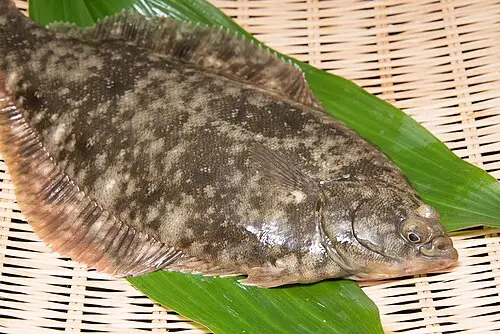
The body is oval and laterally compressed, with both eyes on the right side. The eyed side has dark blackish-brown blotches scattered over a deep brown background, while the blind side is white.
🔍 3. Ecology & Behavior
It feeds mainly on polychaete worms, small crustaceans, and mollusks. It spawns from December to February.
🇰🇷 4. Connection to Korea
According to the National List of Species of Korea, it occurs along all Korean coasts and is used for dried fish, raw fish (hoe), braised dishes, steamed dishes, grilled fish, and gajami-sikhae (fermented flounder) from Hamgyeong Province.
📚 Sources & References
- • IUCN Red List NT (2021) — https://www.iucnredlist.org/species/158637499/158638126
- • IUCN Red List category NT — latest assessment at iucnredlist.org
- • catalogueoflife.org — 4P887
- • iucnredlist.org — 158638126
- • 국가생물종목록(국립생물자원관) ktsn 120000059264 — https://species.nibr.go.kr/home/mainHome.do?cont_link=009&subMenu=009002&contCd=009002&ktsn=120000059264
- • wikidata.org — Q1046212
- • commons.wikimedia.org — File:Shiroshita-karei.jpg
- • fishbase.se — Pseudopleuronectes-yokohamae.html
- • species.nibr.go.kr — mainHome.do
- • Silhouette: PhyloPic — Nathan Hermann · CC0 1.0 (Congeneric silhouette — Pseudopleuronectes americanus)
Recorded dimensions are widely cited representative estimates from public literature and may vary by study or specimen.