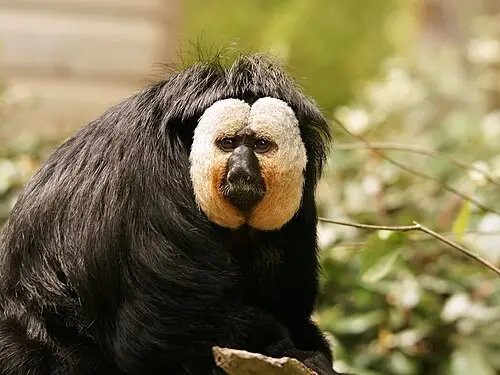
 📸 Photo
Photo: Hans Hillewaert · CC BY-SA 3.0 · Wikimedia Commons Source
White-faced Saki
Pithecia pithecia (White-faced Saki · シロガオサキ)
💡 Everyday Comparisons for Size, Mass & Speed
- 💡 Its average weight of 1.871 kg is similar to a 2 L bottle of water (Comparison).
- 💡 At the Smithsonian's National Zoo, it is fed bananas, grapes, apples, string beans, and mealworms.
Reference standards: coach bus ~12 m, mid-size car ~4.9 m, compact car ~1 t, basketball hoop 3.05 m, credit card 8.56 cm.
Site-computed relative index from recorded values; not a formal scientific metric.
📖 1. Overview
The White-faced Saki is an arboreal monkey of northern South American forests, and males have a black body with a white face.
🦴 2. Anatomy & Morphology
Males have a black body and white face, while females are brown to brownish-gray with two lines running from the eyes toward the nose. The tail is long and bushy, used for balance when leaping rather than grasping objects.
🔍 3. Ecology & Behavior
It mainly eats fruit seeds along with leaves, flowers, and insects, using strong incisors and canines to crack hard shells. It lives in small groups of 2–4 individuals and travels 1–2 km a day.
🇰🇷 4. Connection to Korea
No direct record connecting this species to Korea has been found.
📚 Sources & References
- • IUCN Red List LC (2021) — https://www.iucnredlist.org/species/43942/192447247
- • IUCN Red List category LC — latest assessment at iucnredlist.org
- • mammaldiversity.org — 1000913
- • iucnredlist.org — 192447247
- • wikidata.org — Q832345
- • commons.wikimedia.org — File:Pithecia pithecia.jpg
- • nationalzoo.si.edu — white-faced-saki
- • animaldiversity.org — Pithecia pithecia
- • Silhouette: PhyloPic — T. Michael Keesey · CC0 1.0 (Congeneric silhouette — Pithecia monachus)
Recorded dimensions are widely cited representative estimates from public literature and may vary by study or specimen.