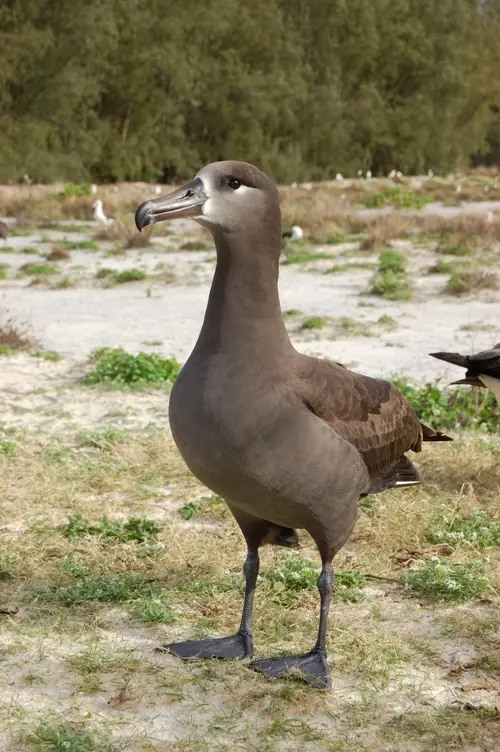
 📸 Photo
Photo: Original uploader was Jlfutari at en.wikipedia · CC BY-SA 3.0 · Wikimedia Commons Source
Black-footed Albatross
Phoebastria nigripes (Black-footed Albatross · クロアシアホウドリ)
💡 Everyday Comparisons for Size, Mass & Speed
- 💡 Its average weight of 7–8 pounds (about 3.6 kg) is slightly heavier than a 3 kg bag of rice (Comparison).
- 💡 It is sociable and curious enough to follow ships for 4–6 hours (Animal Diversity Web).
- 💡 Even young chicks have a habit of picking up small objects to play with (Animal Diversity Web).
Reference standards: coach bus ~12 m, mid-size car ~4.9 m, compact car ~1 t, basketball hoop 3.05 m, credit card 8.56 cm.
Site-computed relative index from recorded values; not a formal scientific metric.
📖 1. Overview
The Black-footed Albatross is an albatross with almost entirely dark gray plumage. It lives on the open ocean and breeds on sandy island beaches.
🦴 2. Anatomy & Morphology
Except for a few white feathers around the bill and under the tail, its entire body is dark gray, with no seasonal plumage change. Males have a slightly larger bill.
🔍 3. Ecology & Behavior
Because it eats fish, fish offal, fish eggs, crabs, crustaceans, squid, and even galley garbage from ships indiscriminately, it is nicknamed the 'feathered pig.' It forages alone at night and stays with its mate for life.
🇰🇷 4. Connection to Korea
No direct record connecting this species to Korea has been found.
📚 Sources & References
- • IUCN Red List NT (2020) — https://www.iucnredlist.org/species/22698350/181896323
- • IUCN Red List category NT — latest assessment at iucnredlist.org
- • doi.org — avilist.v2026
- • iucnredlist.org — 181896323
- • 국가생물종목록(국립생물자원관) ktsn 120000533850 — https://species.nibr.go.kr/home/mainHome.do?cont_link=009&subMenu=009002&contCd=009002&ktsn=120000533850
- • wikidata.org — Q600319
- • commons.wikimedia.org — File:Black footed albatross1.jpg
- • animaldiversity.org — Phoebastria nigripes
- • Silhouette: PhyloPic — Juan Carlos Jerí · CC0 1.0 (Congeneric silhouette — Phoebastria irrorata)
Recorded dimensions are widely cited representative estimates from public literature and may vary by study or specimen.