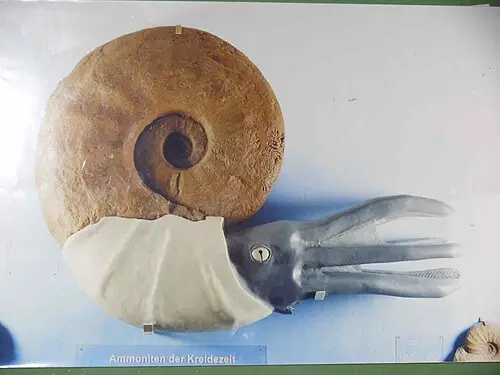
 🎨 Restoration
Restoration: Gunnar Ries · CC BY-SA 3.0 · Wikimedia Commons Source
Life restorations are artistic reconstructions based on fossil evidence; true coloration and soft-tissue details remain uncertain.
Parapuzosia
Parapuzosia seppenradensis (Parapuzosia · パラプゾシア・セッペンラデンシス)
Known only from fossils. The IUCN Red List assesses only species extant since 1500 CE, so fossil taxa are not assigned a category.
💡 Everyday Comparisons for Size, Mass & Speed
- 💡 Its shell diameter of 1.74 m is similar to the height of an adult human, so standing it upright makes it about as tall as a person (Comparison).
- 💡 The Seppenrade specimen is on display at the LWL Museum of Natural History in Münster, Germany.
Reference standards: coach bus ~12 m, mid-size car ~4.9 m, compact car ~1 t, basketball hoop 3.05 m, credit card 8.56 cm.
📖 1. Overview
Parapuzosia seppenradensis is a Late Cretaceous cephalopod known as the largest ammonite in the world. The specimen discovered in 1895 at Seppenrade in Westphalia, Germany is the most famous.
🦴 2. Anatomy & Morphology
The shell diameter of the largest specimen is 1.74 m, and the same study concludes that this species passed through five growth stages as it matured and showed sexual dimorphism in size.
🔍 3. Fossil Record & Paleoecology
Because adult shells are found clustered in narrow areas while remaining rare in nearby strata of the same age, it has been suggested that it may have reproduced once in a lifetime before dying. Whether the increasing size of mosasaurs, the top marine predators of the same era, played a role remains unclear.
🇰🇷 4. Connection to Korea
No direct record connecting this species to Korea has been found.
📚 Sources & References
- • Fossil taxon — the IUCN Red List assesses only species living or extinct since 1500
- • paleobiodb.org — basicTaxonInfo
- • wikidata.org — Q291703
- • commons.wikimedia.org — File:Parapuzosia seppenradensis 3.jpg
- • journals.plos.org — article
- • bspg.snsb.de — neues-zu-riesenammoniten-der-kreidezeit
Recorded dimensions are widely cited representative estimates from public literature and may vary by study or specimen.