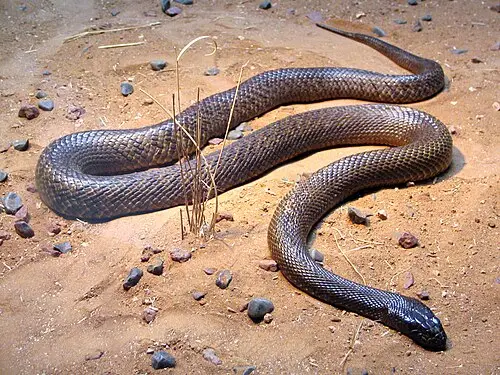
 📸 Photo
Photo: Photo by XLerate · CC BY-SA 3.0 · Wikimedia Commons Source
Inland Taipan
Oxyuranus microlepidotus (Inland Taipan · ナイリクタイパン)
💡 Everyday Comparisons for Size, Mass & Speed
- 💡 A maximum length of 250 cm is longer than a single bed (about 2 m) (Comparison).
- 💡 The Australian Museum notes that because it lives far from human settlements and comes above ground only briefly during the day, ordinary people rarely encounter it, and keepers regard it as a placid snake.
Reference standards: coach bus ~12 m, mid-size car ~4.9 m, compact car ~1 t, basketball hoop 3.05 m, credit card 8.56 cm.
📖 1. Overview
The Inland Taipan is a venomous snake living in remote semi-arid regions of inland Australia; it is often cited as the snake with the most potent venom, yet it is shy and placid.
🦴 2. Anatomy & Morphology
It has a robust body with a deep, rectangular head, and its back ranges from light yellowish brown to dark brown, with the head and neck much darker than the body. It turns darker in winter and fades in summer.
🔍 3. Ecology & Behavior
In the wild, it eats small mammals, especially long-haired rats, cornering them in burrows or ground cracks and biting them multiple times. It is diurnal, active mainly in the early morning, and lays 11–20 eggs (averaging 16) in a clutch.
🇰🇷 4. Connection to Korea
No direct record connecting this species to Korea has been found.
📚 Sources & References
- • IUCN Red List LC (2018) — https://www.iucnredlist.org/species/42493150/42493160
- • IUCN Red List category LC — latest assessment at iucnredlist.org
- • catalogueoflife.org — 4BMPM
- • iucnredlist.org — 42493160
- • wikidata.org — Q72934
- • commons.wikimedia.org — File:Fierce Snake-Oxyuranus microlepidotus.jpg
- • australian.museum — inland-taipan
- • Silhouette: PhyloPic — Michael Scroggie, from original photograph by Gary M. Stolz, USFWS (original photograph in public domain). · CC0 1.0 (Related taxon silhouette — Notechis ater niger)
Recorded dimensions are widely cited representative estimates from public literature and may vary by study or specimen.