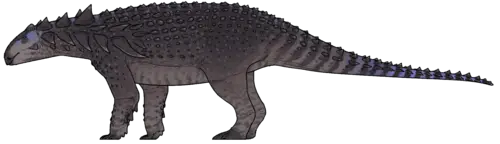
 🎨 Restoration
Restoration: Connor Ashbridge · CC BY 4.0 · Wikimedia Commons Source
Life restorations are artistic reconstructions based on fossil evidence; true coloration and soft-tissue details remain uncertain.
Nipponopelta
Nipponopelta yezoensis (Nipponopelta · Nipponopelta)
Known only from fossils. The IUCN Red List assesses only species extant since 1500 CE, so fossil taxa are not assigned a category.
💡 Everyday Comparisons for Size, Mass & Speed
- 💡 The Mikasa City Museum in Hokkaido notes that visitors can see this fossil in its fossil exhibition hall.
- 💡 Because the genus name Nipponopelta means 'shield of Japan,' the name alone evokes an armored dinosaur.
Reference standards: coach bus ~12 m, mid-size car ~4.9 m, compact car ~1 t, basketball hoop 3.05 m, credit card 8.56 cm.
📖 1. Overview
Nipponopelta yezoensis (genus Nipponopelta) was the first armored dinosaur (nodosaurid) from Japan to receive a formal scientific name. Its name means 'shield of Japan found in Hokkaido.'
🦴 2. Anatomy & Morphology
It belongs to Nodosauridae, a family of armored dinosaurs with prominent shoulder spines. Because the surrounding rock could not be removed any further, the inside of the skull was examined using CT scans.
🔍 3. Fossil Record & Paleoecology
Discovered in the mountains of Yubari in 1995, the fossil has been kept at the Mikasa City Museum. A paper identifying it as a nodosaurid appeared in 2005, and Hokkaido University researchers later named it as a new genus and species.
🇰🇷 4. Connection to Korea
No direct record connecting this species to Korea has been found.
📚 Sources & References
- • Fossil taxon — the IUCN Red List assesses only species living or extinct since 1500
- • paleobiodb.org — basicTaxonInfo
- • wikidata.org — Q141142351
- • commons.wikimedia.org — File:Nipponopelta holotype FPDM.png
- • city.mikasa.hokkaido.jp — 00017844.html
- • Silhouette: PhyloPic — Marie Aimée ALLARD · CC0 1.0 (Related taxon silhouette — Borealopelta markmitchelli)
Recorded dimensions are widely cited representative estimates from public literature and may vary by study or specimen.