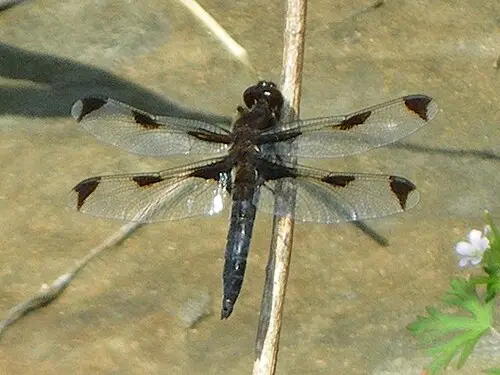
 📸 Photo
Photo: ふうけ · CC BY-SA 4.0 · Wikimedia Commons Source
Bekko tombo
Libellula angelina (Bekko tombo · ベッコウトンボ)
🇰🇷 Class II endangered wildlife (Korea)
💡 Everyday Comparisons for Size, Mass & Speed
- 💡 A body length of about 38 mm is roughly 1.5 times the diameter of a Korean 100-won coin (24 mm) (Comparison).
- 💡 A wingspan of about 7 cm is slightly shorter than the width of a credit card (85.6 mm) (Comparison).
- 💡 When neighborhood ponds and wetlands are filled in for land use, this dragonfly's habitat disappears. The National Institute of Ecology cites wetland reclamation as a cause of its population decline.
Reference standards: coach bus ~12 m, mid-size car ~4.9 m, compact car ~1 t, basketball hoop 3.05 m, credit card 8.56 cm.
📖 1. Overview
The bekko tombo is a dragonfly in the family Libellulidae with distinct brown spots on its wings, living in ponds and wetlands of Korea, Japan, and China. Due to habitat loss, it was assessed as Critically Endangered (CR, 2006) by the IUCN and is a Class II endangered wildlife species in Korea.
🦴 2. Anatomy & Morphology
Its body is brown and elongated oval, with prominent brown spots at the base, middle, and tip of the wings. Females are smaller than males; the abdomen length is 24–31 mm and the hindwing length is 30–34 mm.
🔍 3. Ecology & Behavior
Adults are active from April to June, and both larvae and adults prey on small insects. Females lay eggs by skimming the water surface, and larvae spend about 10 months developing before overwintering as full-grown larvae.
🇰🇷 4. Connection to Korea
Distributed in Incheon, Gyeonggi-do, Gangwon-do, Gyeongsangnam-do, Gyeongsangbuk-do, Jeollanam-do, Chungcheongnam-do, and Jeju Island, it was once common in west coast wetlands but is now mainly found in Gyeongsan, Gyeongsangbuk-do, and Jeju Island. It is a Class II endangered wildlife species (Korea), and its population is declining due to wetland reclamation.
📚 Sources & References
- • IUCN Red List CR (2006) — https://www.iucnredlist.org/species/11928/3315484
- • 멸종위기 야생생물 Ⅱ급 — 국가생물종목록(국립생물자원관) ktsn 120000037391 — https://species.nibr.go.kr/home/mainHome.do?cont_link=009&subMenu=009002&contCd=009002&ktsn=120000037391
- • IUCN Red List category CR — latest assessment at iucnredlist.org
- • Korean protection status: Class II endangered wildlife (Korea)
- • catalogueoflife.org — 728QM
- • iucnredlist.org — 3315484
- • 국가생물종목록(국립생물자원관) ktsn 120000037391 — https://species.nibr.go.kr/home/mainHome.do?cont_link=009&subMenu=009002&contCd=009002&ktsn=120000037391
- • wikidata.org — Q302239
- • commons.wikimedia.org — File:Bekkohtombo0905.jpg
- • env.go.jp — bekkotonbo.html
- • nie.re.kr — view.do
- • Silhouette: PhyloPic — Andy Wilson · CC0 1.0 (Congeneric silhouette — Libellula pulchella)
Recorded dimensions are widely cited representative estimates from public literature and may vary by study or specimen.