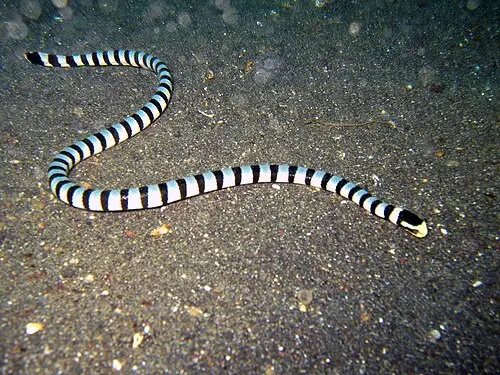
 📸 Photo
Photo: Jens Petersen · CC BY-SA 3.0 · Wikimedia Commons Source
Yellow-lipped Sea Krait
Laticauda colubrina (Yellow-lipped Sea Krait · アオマダラウミヘビ)
💡 Everyday Comparisons for Size, Mass & Speed
- 💡 Its average length of 125 cm is roughly waist-high on an adult human (Comparison).
- 💡 Animal Diversity Web notes that the eggs and meat of Laticauda sea kraits are eaten in places such as the Ryukyu Islands, and their skins were sold in the Philippines and exported to Europe as "Japanese sea snake leather."
Reference standards: coach bus ~12 m, mid-size car ~4.9 m, compact car ~1 t, basketball hoop 3.05 m, credit card 8.56 cm.
Site-computed relative index from recorded values; not a formal scientific metric.
📖 1. Overview
The Yellow-lipped Sea Krait is a sea snake with a yellow upper lip that hunts eels on tropical coral reefs and frequently comes ashore.
🦴 2. Anatomy & Morphology
Its head is mostly black with a yellow band along the lip, and its bluish-grey body has 20–65 black rings. It swims with a paddle-shaped tail and dives up to 60 m thanks to a rearward-extended "saccular lung."
🔍 3. Ecology & Behavior
Its diet consists almost entirely of eels, with larger females mainly catching large conger eels and smaller males catching moray eels. It spends between 1/4 and half of its life on rocky islets courting, laying eggs, digesting food, and shedding its skin.
🇰🇷 4. Connection to Korea
No direct record connecting this species to Korea has been found.
📚 Sources & References
- • IUCN Red List LC (2010) — https://www.iucnredlist.org/species/176750/7296975
- • IUCN Red List category LC — latest assessment at iucnredlist.org
- • catalogueoflife.org — 6P2SW
- • iucnredlist.org — 7296975
- • wikidata.org — Q383702
- • commons.wikimedia.org — File:Laticauda colubrina Lembeh2.jpg
- • animaldiversity.org — Laticauda colubrina
- • Silhouette: PhyloPic — Michael Scroggie, from original photograph by Gary M. Stolz, USFWS (original photograph in public domain). · CC0 1.0 (Related taxon silhouette — Notechis ater niger)
Recorded dimensions are widely cited representative estimates from public literature and may vary by study or specimen.