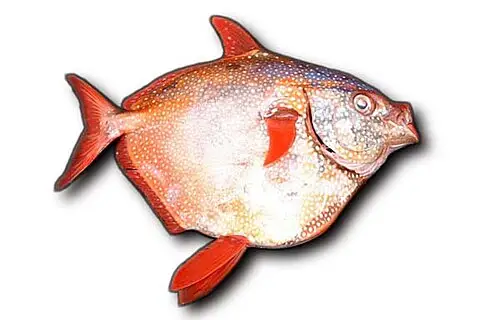
 📸 Photo
Photo: Public domain · Public domain · Wikimedia Commons Source
Bigeye Pacific opah
Lampris megalopsis (Bigeye Pacific opah · Bigeye Pacific opah)
Not Evaluated (NE) on the IUCN Red List yet.
💡 Everyday Comparisons for Size, Mass & Speed
- 💡 Its maximum standard length of 85.3 cm is close to three times the long side of an A4 sheet of paper (29.7 cm) (Comparison).
- 💡 Because it is considered inedible, it is thrown back into the sea immediately when caught (FishBase).
- 💡 It is listed as 'Bulpyeongchi' (Korean name) on the national species list (National List of Species of Korea).
Reference standards: coach bus ~12 m, mid-size car ~4.9 m, compact car ~1 t, basketball hoop 3.05 m, credit card 8.56 cm.
📖 1. Overview
Bigeye Pacific opah is a deep-sea fish distributed across tropical oceans worldwide, known in English as the Bigeye Pacific opah. It is a species treated in a 2018 paper that revised the taxonomy of the opah (Lampris guttatus).
🦴 2. Anatomy & Morphology
Its body is laterally compressed, with 1 dorsal fin spine, 50 dorsal soft rays, and 38 anal soft rays. Its eye diameter is greater than 30% of head length, and its tongue is generally purple.
🔍 3. Ecology & Behavior
When caught, it is considered inedible and immediately discarded back into the sea. According to NOAA, opahs (genus Lampris) feed on squid and deep-sea fish at depths of about 50 m at night and about 200 m during the day.
🇰🇷 4. Connection to Korea
It is listed as 'Bulpyeongchi' (Korean name) on the National List of Species of Korea.
📚 Sources & References
- • IUCN Red List: not evaluated (NE) — cross-checked with the Wikidata conservation-status entry
- • catalogueoflife.org — D549Y
- • 국가생물종목록(국립생물자원관) ktsn 120000528296 — https://species.nibr.go.kr/home/mainHome.do?cont_link=009&subMenu=009002&contCd=009002&ktsn=120000528296
- • wikidata.org — Q52556899
- • commons.wikimedia.org — File:Moonfish 600.jpg
- • fishbase.se — Lampris-megalopsis.html
- • fisheries.noaa.gov — opah
- • Silhouette: PhyloPic — author not recorded · CC0 1.0 (Congeneric silhouette — Lampris)
Recorded dimensions are widely cited representative estimates from public literature and may vary by study or specimen.