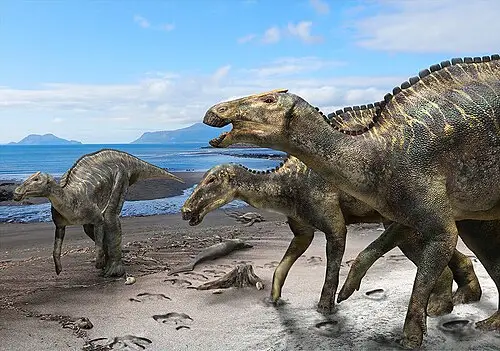
 🎨 Restoration
Restoration: Art by Masato Hattori, published by Yoshitsugu Kobayashi, Tomohiro Nishimura, Ryuji Takasaki, Kentaro Chiba, Anthony R. Fiorillo, Kohei Tanaka, Tsogtbaatar Chin · CC BY 4.0 · Wikimedia Commons Source
Life restorations are artistic reconstructions based on fossil evidence; true coloration and soft-tissue details remain uncertain.
Kamuysaurus
Kamuysaurus japonicus (Kamuysaurus · カムイサウルス・ジャポニクス)
Known only from fossils. The IUCN Red List assesses only species extant since 1500 CE, so fossil taxa are not assigned a category.
💡 Everyday Comparisons for Size, Mass & Speed
- 💡 An estimated body length of about 8 m is about 2/3 of the length of a city bus of about 12 m (Comparison).
- 💡 An estimated weight of about 5.3 tons is the combined weight of three or four 1.5-ton passenger cars (Comparison).
Reference standards: coach bus ~12 m, mid-size car ~4.9 m, compact car ~1 t, basketball hoop 3.05 m, credit card 8.56 cm.
Site-computed relative index from recorded values; not a formal scientific metric.
📖 1. Overview
Kamuysaurus japonicus (genus Kamuysaurus) is a hadrosaurid (duck-billed) dinosaur found in Hokkaido, Japan. A nearly complete skeleton was discovered in marine deposits.
🦴 2. Anatomy & Morphology
It belongs to the Edmontosaurus group (tribe Edmontosaurini), and the paper suggests that it may have had a small crest on top of its head.
🔍 3. Fossil Record & Paleoecology
Hadrosauridae was the most prosperous group of herbivorous dinosaurs in the Late Cretaceous. Growth lines in bone cross-sections show that this individual was a fully grown adult that had stopped growing.
🇰🇷 4. Connection to Korea
No direct record connecting this species to Korea has been found.
📚 Sources & References
- • Fossil taxon — the IUCN Red List assesses only species living or extinct since 1500
- • paleobiodb.org — basicTaxonInfo
- • wikidata.org — Q67201563
- • commons.wikimedia.org — File:Kamuysaurus.jpg
- • pmc.ncbi.nlm.nih.gov — PMC6728324
- • Silhouette: PhyloPic — Will Toosey · CC BY 4.0 (Related taxon silhouette — Hadrosaurus foulkii)
Recorded dimensions are widely cited representative estimates from public literature and may vary by study or specimen.