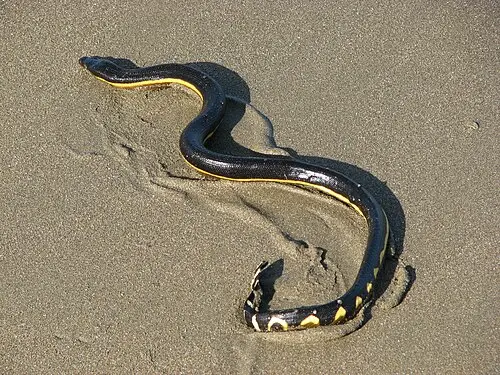
 📸 Photo
Photo: Aloaiza · CC BY 3.0 · Wikimedia Commons Source
Yellowbelly Sea Snake
Hydrophis platurus (Yellowbelly Sea Snake · セグロウミヘビ)
💡 Everyday Comparisons for Size, Mass & Speed
- 💡 Its average length of about 1 m is roughly the length of a long umbrella (Comparison).
- 💡 The Australian Museum notes that storms or strong winds sometimes wash live or dead individuals ashore along Australia's east coast, and that thousands may gather along slicks of floating ocean debris.
Reference standards: coach bus ~12 m, mid-size car ~4.9 m, compact car ~1 t, basketball hoop 3.05 m, credit card 8.56 cm.
📖 1. Overview
The Yellowbelly Sea Snake (Hydrophis platurus) is the most widely distributed and most aquatically adapted snake in the world, spending its entire life drifting on the open ocean.
🦴 2. Anatomy & Morphology
Its upper body is black or dark bluish-brown sharply divided from a yellow underside, and its paddle-shaped tail has black spots or bars on a yellow background. Its scales are small, smooth hexagons.
🔍 3. Ecology & Behavior
In the wild it eats only fish. Floating motionless at the surface, it strikes sideways to catch small fish gathering beneath drifting debris, and can also swim backward to catch prey behind its head.
🇰🇷 4. Connection to Korea
No direct record connecting this species to Korea has been found.
📚 Sources & References
- • IUCN Red List LC (2017) — https://www.iucnredlist.org/species/176738/115883818
- • IUCN Red List category LC — latest assessment at iucnredlist.org
- • catalogueoflife.org — 3N8BL
- • iucnredlist.org — 115883818
- • wikidata.org — Q1247379
- • commons.wikimedia.org — File:Pelamis platura, Costa Rica.jpg
- • australian.museum — yellow-bellied-sea-snake
- • Silhouette: PhyloPic — Christina Zdenek · CC BY 4.0 (Congeneric silhouette — Hydrophis curtus)
Recorded dimensions are widely cited representative estimates from public literature and may vary by study or specimen.