 📸 Photo
Photo: Public domain · Public domain · Wikimedia Commons Source
Orange roughy
Hoplostethus atlanticus (Orange roughy · オレンジラフィー)
Not Evaluated (NE) on the IUCN Red List yet.
💡 Everyday Comparisons for Size, Mass & Speed
- 💡 Its maximum weight of 7 kg is similar to the heaviest 16-pound bowling ball (about 7.3 kg) (Comparison).
- 💡 Its maximum age of 149 years is nearly twice the human lifespan (about 80 years) (Comparison).
- 💡 Because of severe overfishing, the Australian government listed it as a threatened species in 2006 (FishBase).
Reference standards: coach bus ~12 m, mid-size car ~4.9 m, compact car ~1 t, basketball hoop 3.05 m, credit card 8.56 cm.
Site-computed relative index from recorded values; not a formal scientific metric.
📖 1. Overview
The orange roughy is a fish living on deep, cold continental slopes and seamounts, and is among the longest-lived fishes known. It is heavily harvested in commercial fisheries.
🦴 2. Anatomy & Morphology
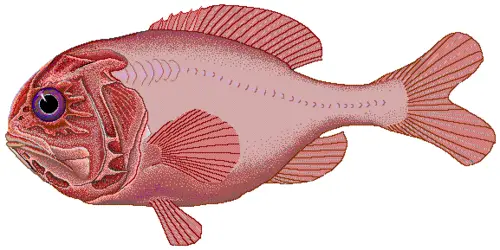
Its body is short, deep, and bright brick-red, while the inside of the mouth and gill cavity is bluish-black. The dorsal fin has 4 to 6 spines and 15 to 19 soft rays.
🔍 3. Ecology & Behavior
It feeds on shrimp, fishes, and squid, grows very slowly, and has been recorded living up to 149 years. It gathers in dense aggregations on seamounts and continental slopes to spawn once a year.
🇰🇷 4. Connection to Korea
No direct record connecting this species to Korea has been found.
📚 Sources & References
- • IUCN Red List: not evaluated (NE) — cross-checked with the Wikidata conservation-status entry
- • catalogueoflife.org — 3MN73
- • wikidata.org — Q1479333
- • commons.wikimedia.org — File:Orange roughy.png
- • fishbase.se — Hoplostethus-atlanticus.html
- • Silhouette: PhyloPic — author not recorded · CC0 1.0
Recorded dimensions are widely cited representative estimates from public literature and may vary by study or specimen.