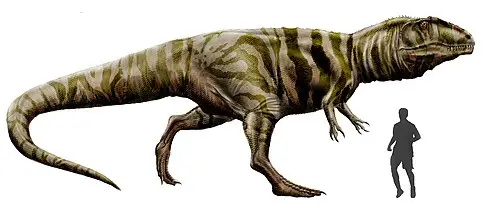
 🎨 Restoration
Restoration: Durbed · CC BY-SA 3.0 · Wikimedia Commons Source
Life restorations are artistic reconstructions based on fossil evidence; true coloration and soft-tissue details remain uncertain.
Giganotosaurus
Giganotosaurus carolinii (Giganotosaurus · Giganotosaurus)
Known only from fossils. The IUCN Red List assesses only species extant since 1500 CE, so fossil taxa are not assigned a category.
💡 Everyday Comparisons for Size, Mass & Speed
- 💡 An estimated body length of about 13 m is about 1 m longer than a city bus (about 12 m), and a weight of about 13.8 tons is about nine passenger cars (about 1.5 tons each) (Comparison).
- 💡 The species name carolinii comes from the name of the fossil hunter who found the first specimen.
Reference standards: coach bus ~12 m, mid-size car ~4.9 m, compact car ~1 t, basketball hoop 3.05 m, credit card 8.56 cm.
Site-computed relative index from recorded values; not a formal scientific metric.
📖 1. Overview
Giganotosaurus carolinii (genus Giganotosaurus) was a huge carnivorous theropod that lived in Argentina during the Cretaceous, and its name means "giant southern lizard." First discovered in Patagonia in 1993 and named in 1995, its species name honors Rubén Carolini, the fossil hunter who found the first specimen.
🦴 2. Anatomy & Morphology
It walked on two legs, and the serrated edges of its long, blade-like teeth were well suited for slicing flesh. Its strong jaws gave it a powerful bite.
🔍 3. Fossil Record & Paleoecology
It was likely the apex predator of its environment. Scholars differ on whether it hunted large sauropods in packs, caught smaller dinosaurs, or scavenged carrion.
🇰🇷 4. Connection to Korea
No direct record connecting this species to Korea has been found.
📚 Sources & References
- • Fossil taxon — the IUCN Red List assesses only species living or extinct since 1500
- • paleobiodb.org — basicTaxonInfo
- • wikidata.org — Q20718182
- • commons.wikimedia.org — File:Chop it! (42641570).jpg
- • nhm.ac.uk — giganotosaurus.html
- • Silhouette: PhyloPic — Tasman Dixon · CC0 1.0
Recorded dimensions are widely cited representative estimates from public literature and may vary by study or specimen.