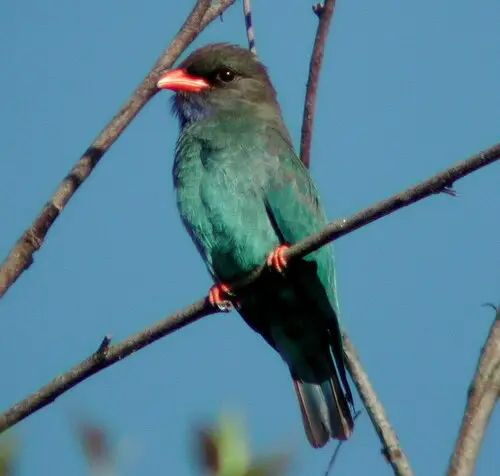
 📸 Photo
Photo: Aviceda · CC BY-SA 3.0 · Wikimedia Commons Source
Oriental Dollarbird
Eurystomus orientalis (Oriental Dollarbird · ブッポウソウ)
💡 Everyday Comparisons for Size, Mass & Speed
- 💡 Its body length of 29.5 cm is almost the same as the long side of an A4 sheet of paper (29.7 cm) (Comparison).
- 💡 Because it lives not only in forests with scattered old trees but also in urban parks and near farmland, it can potentially be seen in nearby parks during summer.
Reference standards: coach bus ~12 m, mid-size car ~4.9 m, compact car ~1 t, basketball hoop 3.05 m, credit card 8.56 cm.
📖 1. Overview
The Oriental Dollarbird is a summer visitor in the roller family with a vivid bluish-green belly, widely distributed across Southeast Asia, Japan, China, and Australia.
🦴 2. Anatomy & Morphology
The male has a blackish-brown crown and sides of the head with a vivid bluish-green belly and undertail coverts, while the female is generally paler than the male. Its bill is thick and short, and its toes are red.
🔍 3. Ecology & Behavior
It mainly preys on insects such as beetles, cicadas, and butterflies. From May to July, it lays 3–5 eggs.
🇰🇷 4. Connection to Korea
It is listed in the National List of Species of Korea as an uncommon summer visitor found nationwide.
📚 Sources & References
- • IUCN Red List LC (2025) — https://www.iucnredlist.org/species/22682920/280900348
- • IUCN Red List category LC — latest assessment at iucnredlist.org
- • doi.org — avilist.v2026
- • iucnredlist.org — 280900348
- • 국가생물종목록(국립생물자원관) ktsn 120000001888 — https://species.nibr.go.kr/home/mainHome.do?cont_link=009&subMenu=009002&contCd=009002&ktsn=120000001888
- • wikidata.org — Q44109
- • commons.wikimedia.org — File:Dollarbird Samcem Dec02.JPG
- • species.nibr.go.kr — mainHome.do
- • Silhouette: PhyloPic — Hugo Gruson · CC0 1.0 (Related taxon silhouette — Coracias caudata)
Recorded dimensions are widely cited representative estimates from public literature and may vary by study or specimen.