 🎨 Restoration
Restoration: J. Jung, K. Kim, H. Jo & J. A. Clarke · CC BY 4.0 · Wikimedia Commons Source
Life restorations are artistic reconstructions based on fossil evidence; true coloration and soft-tissue details remain uncertain.
Doolysaurus
Doolysaurus huhmini (Doolysaurus · Doolysaurus)
Known only from fossils. The IUCN Red List assesses only species extant since 1500 CE, so fossil taxa are not assigned a category.
💡 Everyday Comparisons for Size, Mass & Speed
- 💡 Because the juvenile is said to have been about the size of a turkey, it can be compared to a single turkey (Comparison).
- 💡 The genus name was taken from the Korean cartoon "Dooly the Little Dinosaur."
Reference standards: coach bus ~12 m, mid-size car ~4.9 m, compact car ~1 t, basketball hoop 3.05 m, credit card 8.56 cm.
📖 1. Overview
Doolysaurus huhmini (genus Doolysaurus) is a new Korean dinosaur named in 2026, represented by the juvenile fossil of a small, two-legged thescelosaurid dinosaur.
🦴 2. Anatomy & Morphology
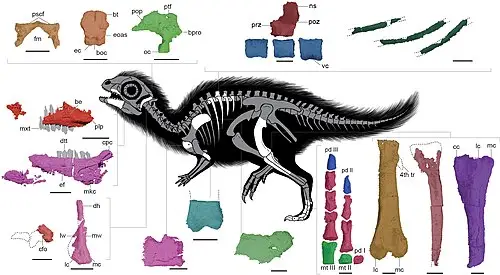
The specimen consists of skull fragments, vertebrae, hindlimb bones, and dozens of gastroliths, and when fully grown it may have been covered in down-like fibers.
🔍 3. Fossil Record & Paleoecology
Growth marks on the femur indicate an individual about two years old and about the size of a turkey, while an adult may have grown to about twice that size. Because of its many gastroliths, it is considered an omnivore that ate plants, insects, and small animals.
🇰🇷 4. Connection to Korea
Discovered on Aphaedo in 2023 by researcher Jo Hye-min of the Korea Dinosaur Research Center, the fossil was published as a new species in March 2026 in "Fossil Record," and its species name honors Korean dinosaur researcher Huh Min.
📚 Sources & References
- • Fossil taxon — the IUCN Red List assesses only species living or extinct since 1500
- • paleobiodb.org — basicTaxonInfo
- • wikidata.org — Q138722516
- • commons.wikimedia.org — File:Doolysaurus huhmini (skeletal reconstruction).jpg
- • doi.org — fr.29.178152
- • fr.pensoft.net — 178152
- • global.utexas.edu — new-species-baby-dino-named-iconic-korean-cartoon
- • sci.news — doolysaurus-huhmini-14635.html
- • Silhouette: PhyloPic — Cy Marchant · CC BY 4.0 (Related taxon silhouette — Fona herzogae)
Recorded dimensions are widely cited representative estimates from public literature and may vary by study or specimen.