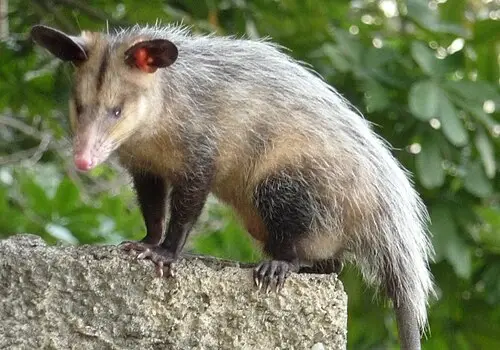
 📸 Photo
Photo: Rabipelao.jpg : Juan Tello derivative work: WolfmanSF ( talk ) · CC BY 2.0 · Wikimedia Commons Source
Northern Black-eared Opossum
Didelphis marsupialis (Northern Black-eared Opossum · ミナミオポッサム)
💡 Everyday Comparisons for Size, Mass & Speed
- 💡 Its average weight of 1.53 kg is similar to a 1.5 L bottle of water, and its maximum body length of 43 cm is about 1.5 times the long side of A4 paper (29.7 cm) (Comparison).
- 💡 People hunt it for sport and food and it enters the illegal bushmeat trade, while some cultures use its fat as a remedy for ailments such as indigestion and rheumatism.
Reference standards: coach bus ~12 m, mid-size car ~4.9 m, compact car ~1 t, basketball hoop 3.05 m, credit card 8.56 cm.
Site-computed relative index from recorded values; not a formal scientific metric.
📖 1. Overview
The Northern Black-eared Opossum is an opossum widespread across Central and South America that is a habitat generalist and tolerates human-altered environments well.
🦴 2. Anatomy & Morphology
Its thick fur has long guard hairs that give it a disheveled look, with a black or gray back and a yellow to cream belly. Its face is whitish with black rings around the eyes, its large ears are completely black, and its hairless tail is prehensile.
🔍 3. Ecology & Behavior
An opportunistic omnivore, it eats invertebrates, vertebrates, leaves, fruits, nectar, and carrion. It is active alone at night and spends the day in tree hollows or underground burrows.
🇰🇷 4. Connection to Korea
No direct record connecting this species to Korea has been found.
📚 Sources & References
- • IUCN Red List LC (2021) — https://www.iucnredlist.org/species/40501/197310576
- • IUCN Red List category LC — latest assessment at iucnredlist.org
- • mammaldiversity.org — 1000021
- • iucnredlist.org — 197310576
- • wikidata.org — Q194663
- • commons.wikimedia.org — File:Rabipelao2.jpg
- • animaldiversity.org — Didelphis marsupialis
- • Silhouette: PhyloPic — Milena Cavalcanti, Patricia Pilatti & Diego Astúa · CC BY 4.0 (Congeneric silhouette — Didelphis)
Recorded dimensions are widely cited representative estimates from public literature and may vary by study or specimen.