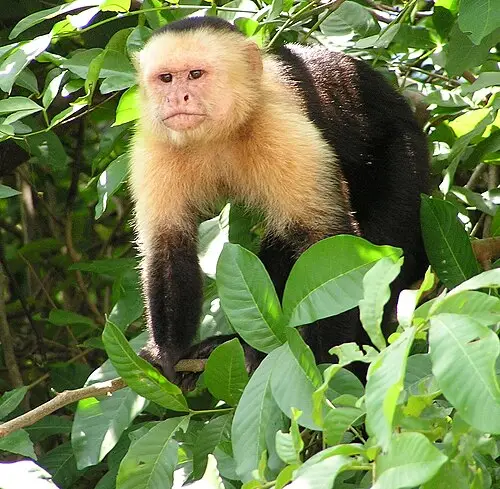
 📸 Photo
Photo: David M. Jensen ( Storkk ) · CC BY-SA 3.0 · Wikimedia Commons Source
White-faced Capuchin
Cebus capucinus (White-faced Capuchin · ノドジロオマキザル)
💡 Everyday Comparisons for Size, Mass & Speed
- 💡 A male's maximum weight of 4 kg equals two 2 L bottles of water (Comparison).
- 💡 It is hunted for food, widely kept as a pet, and common in zoos, where most individuals are born through captive breeding (ADW positive economic importance).
Reference standards: coach bus ~12 m, mid-size car ~4.9 m, compact car ~1 t, basketball hoop 3.05 m, credit card 8.56 cm.
Site-computed relative index from recorded values; not a formal scientific metric.
📖 1. Overview
The white-faced capuchin is an inquisitive, intelligent monkey adapted to a wide variety of forests in Central America and neighboring regions.
🦴 2. Anatomy & Morphology
Its back and hindquarters are jet black, while its upper chest, forearms, and the fur around its face are white, topped by a black cap on the head. It uses its tail to grasp food or support its body, and shows the greatest size difference between males and females among capuchins.
🔍 3. Ecology & Behavior
It feeds mainly on fruits and nuts, opportunistically catching insects and small vertebrates as well. Living in troops of 18–20 individuals, it is an adventurous eater willing to sample unfamiliar foods.
🇰🇷 4. Connection to Korea
No direct record connecting this species to Korea has been found.
📚 Sources & References
- • IUCN Red List VU (2021) — https://www.iucnredlist.org/species/81257277/191708164
- • IUCN Red List category VU — latest assessment at iucnredlist.org
- • mammaldiversity.org — 1000831
- • iucnredlist.org — 191708164
- • wikidata.org — Q585189
- • commons.wikimedia.org — File:Capuchin Costa Rica.jpg
- • animaldiversity.org — Cebus capucinus
- • Silhouette: PhyloPic — Sarah Werning · CC BY 3.0 (Congeneric silhouette — Cebus)
Recorded dimensions are widely cited representative estimates from public literature and may vary by study or specimen.