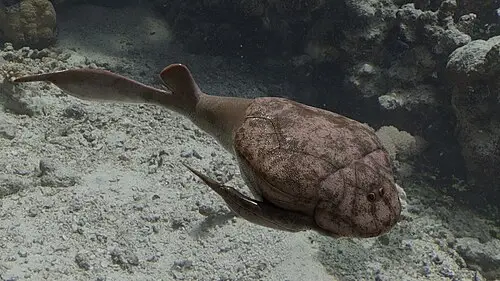
 🎨 Restoration
Restoration: Paleobiome · CC0 · Wikimedia Commons Source
Life restorations are artistic reconstructions based on fossil evidence; true coloration and soft-tissue details remain uncertain.
Bothriolepis
Bothriolepis canadensis (Bothriolepis · Bothriolepis)
Known only from fossils. The IUCN Red List assesses only species extant since 1500 CE, so fossil taxa are not assigned a category.
💡 Everyday Comparisons for Size, Mass & Speed
- 💡 A specimen length of 25 cm is slightly longer than the short side of an A4 sheet of paper (21 cm) (Comparison).
- 💡 Its polygonal bony plates look so much like a turtle shell that the geologist who first discovered it called the fossil a "little turtle with footprints."
Reference standards: coach bus ~12 m, mid-size car ~4.9 m, compact car ~1 t, basketball hoop 3.05 m, credit card 8.56 cm.
📖 1. Overview
Bothriolepis canadensis is a Late Devonian placoderm (armored fish) and the most common fish fossil in the Escuminac Formation at Miguasha, Quebec, Canada. Well-preserved fossils look like intricately carved jewelry boxes.
🦴 2. Anatomy & Morphology
Its head and trunk were covered in rigid bony armor fused together, and instead of ordinary fish fins, it had a pair of stiff arms with two joints. Its tail was slender and had almost no scales, so it is rarely preserved as a fossil, and it also had esophageal pouches alongside its gills that may have functioned as lungs.
🔍 3. Fossil Record & Paleoecology
Because its intestine was spiral-shaped and found packed with mud, it is regarded as a mud-eating animal. With a flattened body compressed from the back, it is also thought to have walked on the bottom in shallow water using its arms and possibly even ventured out of the water.
🇰🇷 4. Connection to Korea
No direct record connecting this species to Korea has been found.
📚 Sources & References
- • Fossil taxon — the IUCN Red List assesses only species living or extinct since 1500
- • paleobiodb.org — basicTaxonInfo
- • wikidata.org — Q140479359
- • commons.wikimedia.org — File:Bothriolepis canadensis based on 2014 reconstruction.jp
- • bac-lac.wayback.archive-it.org — 23 e.php
- • hoopermuseum.carleton.ca — thirteenth.html
- • Silhouette: PhyloPic — Steven Coombs · CC0 1.0
Recorded dimensions are widely cited representative estimates from public literature and may vary by study or specimen.