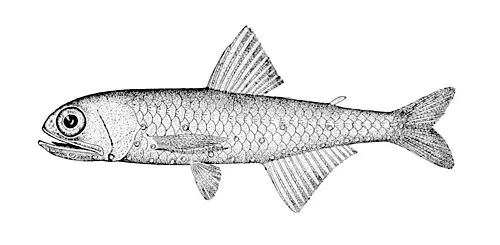
 📸 Photo
Photo: Unknown author Unknown author · Public domain · Wikimedia Commons Source
Skinnycheek lanternfish
Benthosema pterotum (Skinnycheek lanternfish · Skinnycheek lanternfish)
💡 Everyday Comparisons for Size, Mass & Speed
- 💡 Its maximum total length of 7 cm is about two and a half times the diameter of a Korean 500-won coin (2.65 cm) (Comparison).
- 💡 Its average weight of 0.25 g is very light, about a dozen times the weight of a single grain of rice (about 0.02 g) (Comparison).
- 💡 Because it is rich in nutrients, it can be used for animal feed or fertilizer, but people rarely eat it because of its high wax ester content (Animal Diversity Web).
Reference standards: coach bus ~12 m, mid-size car ~4.9 m, compact car ~1 t, basketball hoop 3.05 m, credit card 8.56 cm.
Site-computed relative index from recorded values; not a formal scientific metric.
📖 1. Overview
The Skinnycheek lanternfish is a small marine fish in the lanternfish family with light-producing organs (photophores) on its body. It stays in deep water during the day and rises to shallower water at night.
🦴 2. Anatomy & Morphology
Its body is a laterally flattened spindle shape, pale yellow on the back and silvery white on the belly, with silvery-white photophores on the belly and sides. It has no teeth on the upper jaw, and small teeth on the lower jaw, vomer, and palatine bones.
🔍 3. Ecology & Behavior
It rises at night to feed on zooplankton such as crustaceans and copepods, and moves down to deeper waters during the day to stay in schools. It plays an important role in the marine ecosystem as prey for larger fishes.
🇰🇷 4. Connection to Korea
According to the National List of Species of Korea, it lives off the west coast of Korea.
📚 Sources & References
- • IUCN Red List LC (2010) — https://www.iucnredlist.org/species/155260/4759559
- • IUCN Red List category LC — latest assessment at iucnredlist.org
- • catalogueoflife.org — LHZT
- • iucnredlist.org — 4759559
- • 국가생물종목록(국립생물자원관) ktsn 120000057806 — https://species.nibr.go.kr/home/mainHome.do?cont_link=009&subMenu=009002&contCd=009002&ktsn=120000057806
- • wikidata.org — Q2896752
- • commons.wikimedia.org — File:Benthosema pterotum.jpg
- • fishbase.se — Benthosema-pterotum.html
- • animaldiversity.org — Benthosema pterotum
- • species.nibr.go.kr — mainHome.do
- • Silhouette: PhyloPic — Lily Hughes · CC0 1.0 (Congeneric silhouette — Benthosema glaciale)
Recorded dimensions are widely cited representative estimates from public literature and may vary by study or specimen.