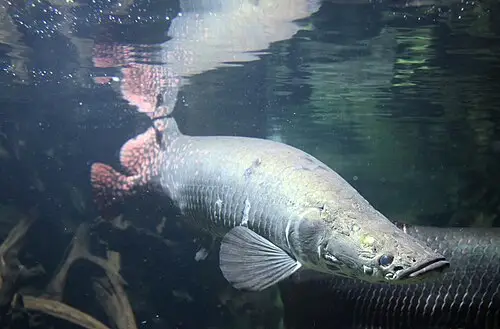
 📸 Photo
Photo: This illustration was made by Citron You must credit this : Citron / CC-BY-SA-3.0 · CC BY-SA 3.0 · Wikimedia Commons Source
Arapaima
Arapaima gigas (Arapaima · ピラルクー)
💡 Everyday Comparisons for Size, Mass & Speed
- 💡 Its maximum length of 4.5 m is similar to the length of a passenger car (Comparison).
- 💡 Its maximum weight of 200 kg is equal to the weight of 10 bags of rice weighing 20 kg each (Comparison).
- 💡 Locally, people catch it with harpoons or large nets for food. A single fish yields 70 kg of meat, its bony tongue is used to scrape guarana, and its scales are used as nail files (ADW).
- 💡 It is also traded as an aquarium fish, but keeping it requires a very large tank (ADW).
Reference standards: coach bus ~12 m, mid-size car ~4.9 m, compact car ~1 t, basketball hoop 3.05 m, credit card 8.56 cm.
Site-computed relative index from recorded values; not a formal scientific metric.
📖 1. Overview
The Arapaima is one of the largest freshwater fishes in the world, native to the Amazon River basin. It lives in tropical freshwater lakes, rivers, and swamps.
🦴 2. Anatomy & Morphology
Its body is huge, with scales reaching up to 6 cm in length. The body is gray with orange speckles near the tail. It is an air-breathing fish that must come up to the surface to breathe.
🔍 3. Ecology & Behavior
It is a predator that mainly eats other fish and rises to the surface every 10–20 minutes to gulp air. During the low-water season, it builds a nest about 50 cm wide and 15 cm deep on a sandy bottom and guards its eggs and young.
🇰🇷 4. Connection to Korea
No direct record connecting this species to Korea has been found.
📚 Sources & References
- • IUCN Red List DD (1996) — https://www.iucnredlist.org/species/1991/9110195
- • IUCN Red List category DD — latest assessment at iucnredlist.org
- • catalogueoflife.org — G5TN
- • iucnredlist.org — 9110195
- • wikidata.org — Q145409
- • commons.wikimedia.org — File:Arapaima gigas captivity.jpg
- • fishbase.se — Arapaima-gigas.html
- • animaldiversity.org — Arapaima gigas
- • Silhouette: PhyloPic — Andy Wilson · CC0 1.0
Recorded dimensions are widely cited representative estimates from public literature and may vary by study or specimen.