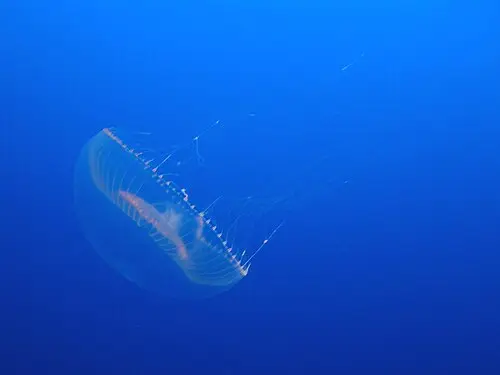
 📸 Photo
Photo: Mnolf · CC BY-SA 3.0 · Wikimedia Commons Source
Crystal jelly
Aequorea victoria (Crystal jelly · オワンクラゲ)
Not Evaluated (NE) on the IUCN Red List yet.
💡 Everyday Comparisons for Size, Mass & Speed
- 💡 Its maximum bell diameter of 7 cm is slightly smaller than the long side of a credit card (about 8.6 cm) (Comparison).
- 💡 Green fluorescent protein (GFP), first observed in this jellyfish in 1962, became a life-science tool for visualizing previously invisible processes such as nerve cell development and cancer cell metastasis, earning the 2008 Nobel Prize in Chemistry (Nobel Prize Committee).
Reference standards: coach bus ~12 m, mid-size car ~4.9 m, compact car ~1 t, basketball hoop 3.05 m, credit card 8.56 cm.
📖 1. Overview
The crystal jelly is a small, transparent jellyfish living along the west coast of North America, where green fluorescent protein (GFP) was first discovered.
🦴 2. Anatomy & Morphology
It is a small jellyfish with a maximum bell diameter of 7 cm.
🔍 3. Ecology & Behavior
It preys on fish eggs and larvae, zooplankton, and other jellyfish and comb jellies. It reproduces asexually by budding during the polyp stage and sexually by releasing gametes into the water during the medusa stage.
🇰🇷 4. Connection to Korea
No direct record connecting this species to Korea has been found.
📚 Sources & References
- • IUCN Red List: not evaluated (NE) — cross-checked with the Wikidata conservation-status entry
- • marinespecies.org — aphia.php
- • wikidata.org — Q133055
- • sealifebase.se — Aequorea-victoria.html
- • nobelprize.org — press-release
Recorded dimensions are widely cited representative estimates from public literature and may vary by study or specimen.