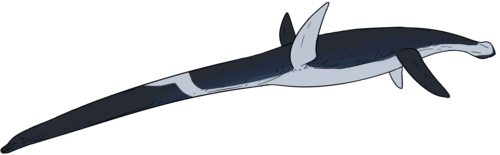
 🎨 复原图
Life restoration
复原图: Connor Ashbridge · CC BY-SA 4.0 · Wikimedia Commons 原文件
活体复原图是基于化石证据的科学艺术复原,真实体色与软组织细节仍存在不确定性。
薄板龙 (蛇颈龙)
Elasmosaurus platyurus (Elasmosaurus · エラスモサウルス)
仅见于化石的物种。IUCN红色名录仅评估公元1500年以来生存或灭绝的物种,因此无评估等级。
💡 用日常生活实例看体型·体重·速度
- 📏 体长 10.3m — 约为大巴车(约12米)的 0.9倍长
- 🏢 肩高 1.8m — 约为1.75米人类身高的 1倍
- ⚖️ 体重 2.1吨 — 约相当于 2.1辆小型汽车(每辆约1吨)的重量
- ⚡ 速度 28km/h — 约为博尔特百米世界纪录平均速度(37.6km/h)的 0.7倍
参考基准:大巴车约12米、中型轿车约4.9米、小型汽车约1吨、篮球筐3.05米、银行卡8.56厘米等通用规格。
根据上述数值计算的网站相对换算值,并非正式科学测量指标。
📖 1. 概览
代表性的长颈龙(蛇颈龙类),全长10.3米中仅颈部就长达7.1米(由72节颈椎组成)。
🌐 Wikipedia 摘要摘录Elasmosaurus is a genus of plesiosaur that lived in North America during the Campanian stage of the Late Cretaceous period, at about 80.6 to 77 million years ago. The first specimen was discovered in 1867 near Fort Wallace, Kansas, US, and was sent to the American paleontologist Edward Drinker Cope, who named it E. platyurus in 1868. The generic name means "thin-plate reptile", and the specific name means "flat-tailed". Cope originally reconstructed the skeleton of Elasmosaurus with the skull at the end of the tail, an error which was made light of by the paleontologist Othniel Charles Marsh, and became part of their "Bone Wars" rivalry. Only one incomplete Elasmosaurus skeleton is definitely known, consisting of a fragmentary skull, the spine, and now lost pectoral and pelvic girdles, and a single species is recognized today; other species are now considered invalid or have been moved to other genera. A fragmentary specimen from Germany may belong to this genus.
🦴 2. 身体结构与特征
它像在水下扇动翅膀一样摆动四只鳍状肢进行游动。
🔍 3. 化石记录与古生态
它是19世纪古生物学界“化石战争(Bone Wars)”的标志性标本。
🇰🇷 4. 与韩国的关联
它是解释中生代海生爬行动物水生适应演化的代表物种。
📚 来源与参考资料
- • Wikipedia “Elasmosaurus”
- • Wikidata Q20717895
- • Fossil taxon — the IUCN Red List assesses only species living or extinct since 1500
- • 剪影: PhyloPic — E. D. Cope (modified by T. Michael Keesey, Michael P. Taylor & Matthew J. Wedel) · CC BY 3.0
数值为公开文献中广泛引用的代表性估计值,可能因研究或个体而异。