 🦴 化石
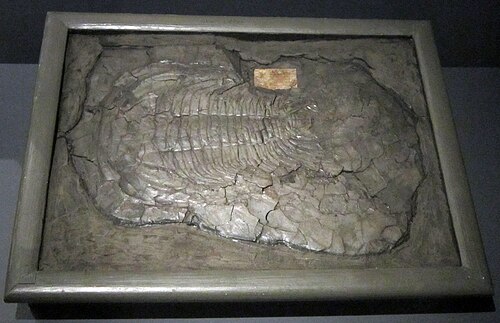
This P. paradoxissimus specimen at the Copenhagen Zoological Museum was described by Carl Linnaeus
写真: FunkMonk · CC BY-SA 3.0 · Wikimedia Commons 元ファイル
三葉虫
Paradoxides davidis (Trilobite (Paradoxides) · 三葉虫)
化石のみで知られる種です。IUCNレッドリストは西暦1500年以降に生息していた種のみを評価するため、等級はありません。
💡 身近な例で見るサイズ・重さ・速度
- 📏 体長 45cm — A4用紙の長辺(29.7cm)の約1.5枚分
- 🧍 体長 45cm — A4用紙の長辺(29.7cm)の約1.5枚分
比較基準: 大型バス約12m、乗用車約4.9m、軽自動車約1t、バスケットゴール3.05m、クレジットカード8.56cmなどの標準規格。
📖 1. 概要
古生代の約2億7,000万年にわたって海を支配した代表的な示準化石です。
🌐 Wikipedia 要約抜粋Paradoxides is a genus of large to very large trilobite found throughout the world during the Middle Cambrian period. One record-breaking specimen of Paradoxides davidis, described by John William Salter in 1863, is 37 cm (15 in). The cephalon was semicircular with free cheeks ending in long, narrow, recurved spines. Eyes were crescent shaped providing an almost 360° view, but only in the horizontal plane. Its elongate thorax was composed of 19–21 segments and adorned with longish, recurved pleural spines. Its pygidium was comparatively small. Paradoxides is a characteristic Middle-Cambrian trilobite of the 'Atlantic' (Avalonian) fauna. Avalonian rocks were deposited near a small continent called Avalonia in the Paleozoic Iapetus Ocean. Avalonian beds are now in a narrow strip along the East Coast of North America, and in Europe.
🦴 2. 体の構造と特徴
三葉虫は方解石(炭酸カルシウム)の結晶でできたレンズを持つ複眼を備えていました。化石として残った眼の中で最も古い部類に入ります。
🔍 3. 化石記録と古生態
ペルム紀末の大量絶滅の際に地球上から完全に姿を消しました。
🇰🇷 4. 韓国との関わり
江原道太白・寧越の古生代朝鮮累層群から数多くの三葉虫化石が発掘されています。
📚 出典・確認先
- • Wikipedia “Paradoxides”
- • Wikidata Q7134471
- • Fossil taxon — the IUCN Red List assesses only species living or extinct since 1500
- • シルエット: PhyloPic — Charles Doolittle Walcott (vectorized by T. Michael Keesey) · Public Domain Mark 1.0 (近縁分類群のシルエット — Olenellus thompsoni)
数値は公開資料で広く引用される代表的な推定値であり、研究や個体により異なる場合があります。